
Tour Africa Archive | Originally published on Tour Africa in 2018
Original event covered: Osun-Osogbo Festival, August 2012
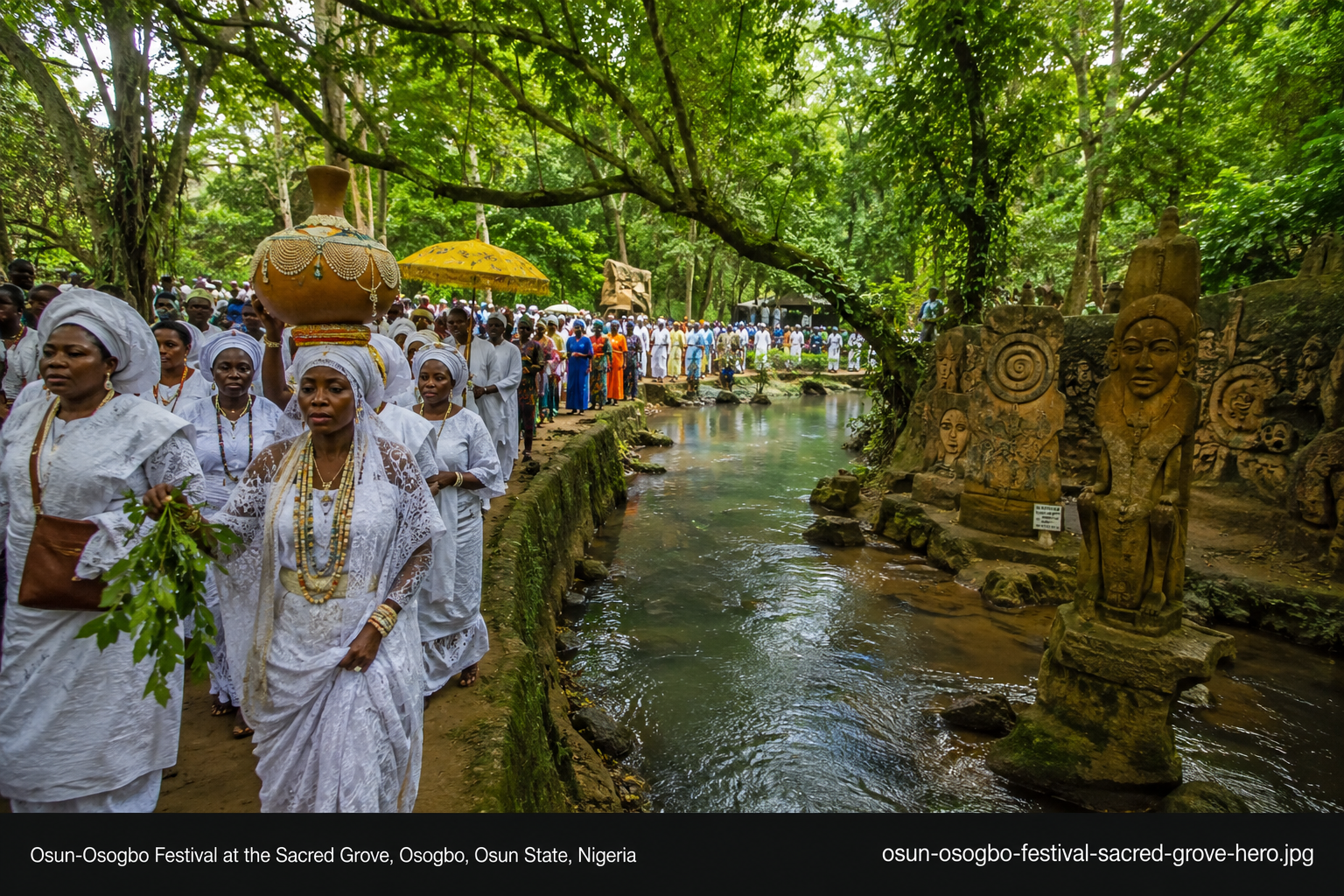
The Osun-Osogbo Festival is one of Nigeria’s most significant celebrations of Yoruba culture, spirituality and heritage. Every year, devotees, traditional leaders, tourists, cultural enthusiasts and visitors converge on Osogbo, Osun State, for a celebration centred on the sacred Osun-Osogbo Grove and the Osun River.
The festival has deep cultural significance. It also plays an important role in cultural tourism and destination development.
Tour Africa covered the festival in 2012. This archival report revisits that coverage and documents the procession, traditional rites, tourism activities, entertainment and efforts to improve the organisation of the celebration.
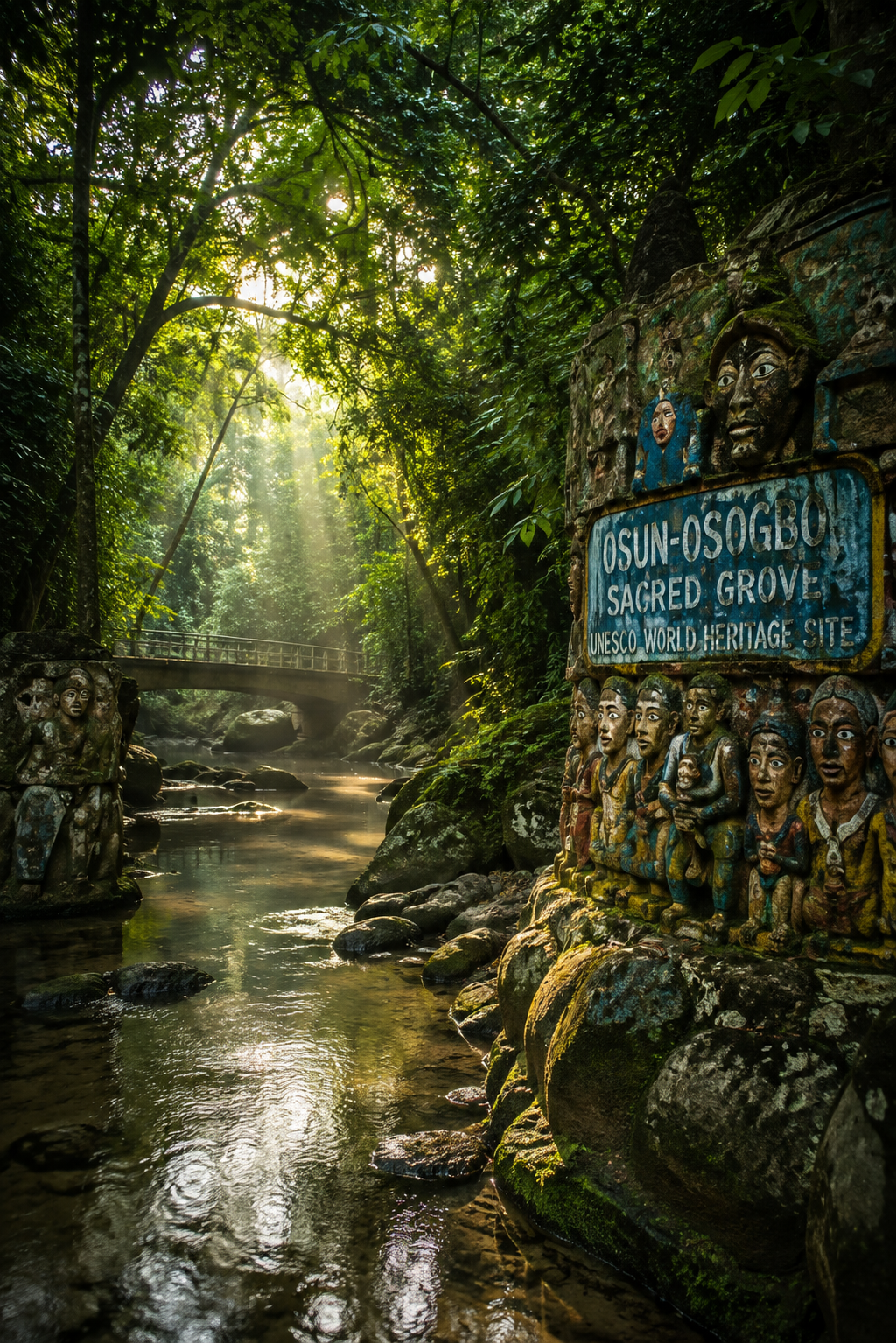
Today, the Osun-Osogbo Sacred Grove remains a UNESCO World Heritage Site. UNESCO describes it as one of the last surviving sacred groves in southern Nigeria and an important symbol of Yoruba identity. The 75-hectare property contains shrines, sculptures, artworks and sacred spaces along the Osun River.
Tour Africa’s 2012 Osun-Osogbo Festival Report
The 2012 festival procession began behind schedule at about noon.
By then, many devotees had already arrived at the grove. Some had returned with gallons filled with water from the Osun River. Others remained at the grove to witness the ritual celebration and joined the procession of the Arugba.
Despite the large crowd, festival organisers placed considerable emphasis on crowd control and security.
The arrangements helped create a smoother experience for visitors and tourists. Security personnel managed access to the grove, while traffic flowed relatively freely on the roads leading to the festival site.
The organisation also reflected collaboration among the festival custodians, the festival consultant, Infogem, corporate sponsors and the Osun State Government.
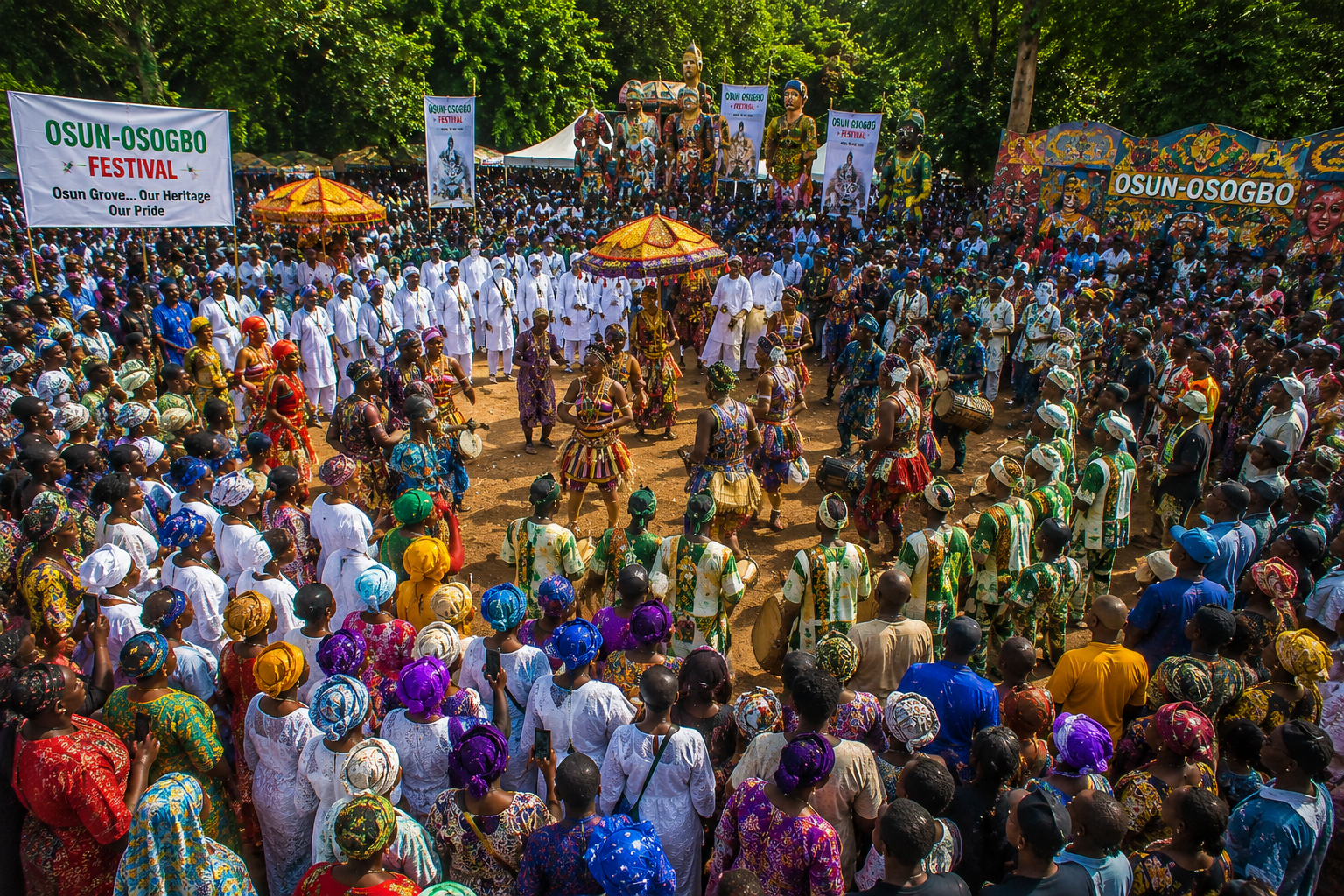
Image note: Images used in this updated article are AI generated/ illustrative images of Osun-Osogbo and are not the original photographs from Tour Africa’s 2012 coverage.
The Arugba Leads the Procession
The journey to the grove began after the Ataoja of Osogboland, Oba Jimoh Oyetunji, Olanipekun Laroye II, blessed the Arugba and the priests and priestesses accompanying her.
The procession covered approximately three kilometres before reaching the grove.
Along the route, cultural groups entertained spectators with traditional dances, folk songs and other performances. Associations and age groups also joined the celebration as the procession moved towards the sacred grove.
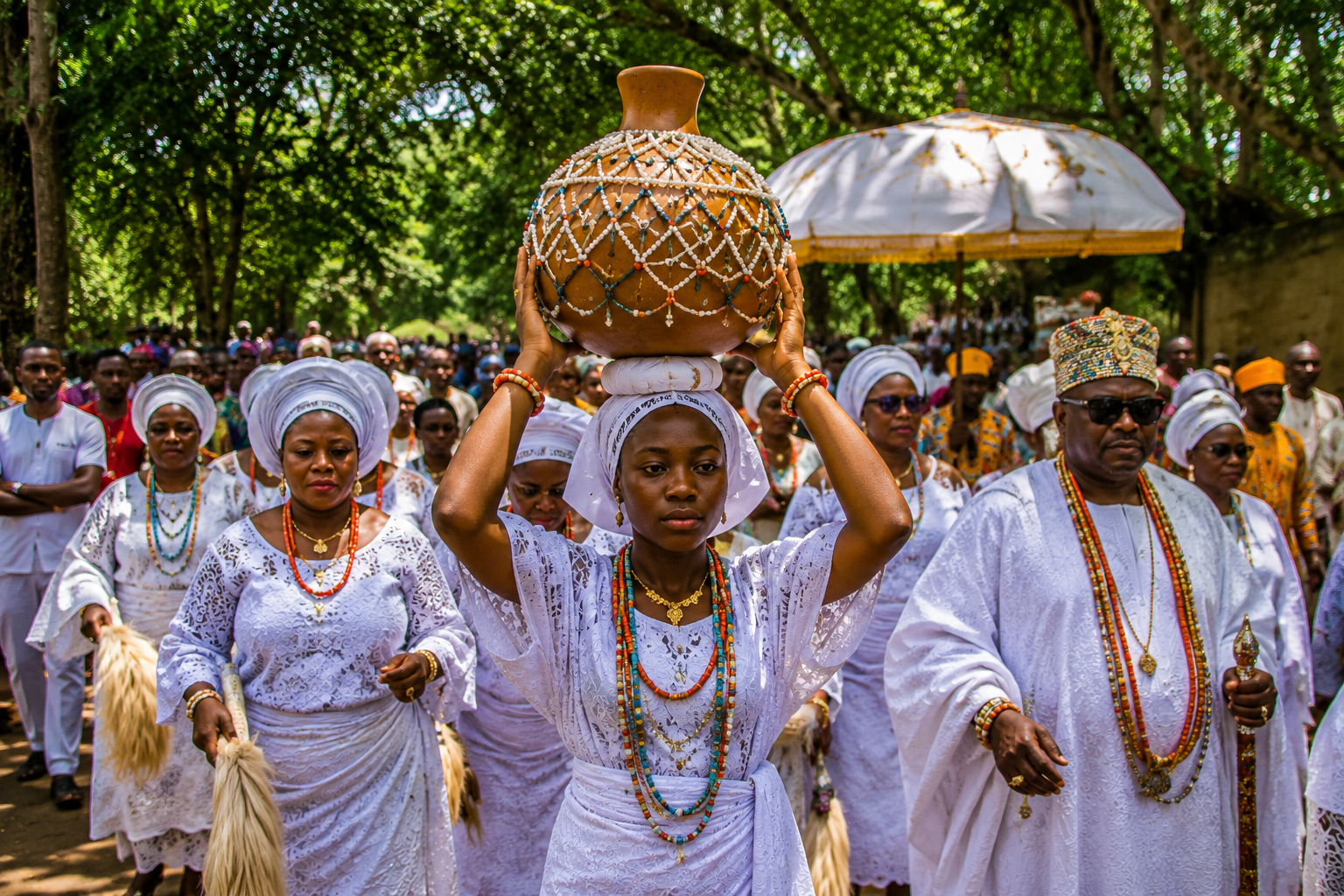
The Arugba remained at the centre of the procession.
According to festival tradition, people along the procession route snapped their fingers over their heads three times as the Arugba passed. Participants observed the practice as a way of warding off evil and misfortune.
Meanwhile, the crowd around the grove continued to grow.
A Crowded Grove Welcomes the Arugba
By the time the procession reached the grove, devotees and tourists had already filled the main arena.
The heavy crowd created a challenge because there was little room for the Arugba to enter.
However, security personnel had established controlled entrance and exit points. As a result, the procession was able to move into the grove.
The Arugba then made a ceremonial entrance among the devotees.
She paid obeisance to the Deputy Governor of Osun State, Chief Mrs Titilayo Laoye-Tomori, the Ataoja of Osogboland and the Ataoja’s chiefs in council.
She was subsequently escorted to the bank of the Osun River, where she deposited the contents of the calabash as part of the traditional rites.
Tradition, Ritual and Community
The festival also provided an opportunity for families, groups and traditional leaders from Osogboland to reaffirm their connection with the Ataoja.
High-ranking chiefs, families, groups, sons and daughters of Osogboland approached the Ataoja according to the established order. In return, Oba Oyetunji blessed them.
Therefore, the festival served more than a religious purpose. It brought together cultural identity, community participation, traditional authority and tourism.
That combination remains one of the reasons the Osun-Osogbo Festival attracts attention beyond Osogbo.
Government Support for Culture and Tourism
Speaking at the 2012 festival, Osun State Deputy Governor Chief Mrs Titilayo Laoye-Tomori said the state government considered culture and tourism important areas of development.
She explained that the government was working to package cultural festivals in the state for wider international recognition.
She also highlighted investment in the festival and the government’s ambition to develop the grove into a major international tourist centre.
According to her, tourism could generate significant economic benefits for Osun State if the sector received appropriate development and investment.
She also encouraged members of the Osogbo community and the wider Yoruba diaspora to return home and participate in cultural celebrations.
Ataoja Highlights the Importance of Heritage
The 18th custodian of the festival and Ataoja of Osogboland, Oba Jimoh Oyetunji, Olanipekun Laroye II, also addressed the gathering.
It was his second appearance at the festival following his enthronement.
Oba Oyetunji acknowledged the people of Osogboland for preserving and promoting their heritage. He described their commitment as an expression of service, peace, unity, support and love.
He also prayed for continued peace and unity among the people of Osogboland.
In addition, the Ataoja recognised the contribution of government agencies, corporate organisations and other stakeholders involved in preserving and promoting the cultural heritage of the Osun-Osogbo Grove.
He particularly noted improvements to roads leading to the grove, traffic management, crowd control, the construction of a permanent pavilion and beautification projects.
He also highlighted support for tourist centres and the provision of free rail transportation to and from Lagos, which helped attract additional participants to the 2012 celebration.
NTDC Surveys Tourist Activities
The Nigerian Tourism Development Corporation (NTDC) also participated in the 2012 festival.
Officials conducted a survey of tourist arrivals to Osun State during the celebration.
The exercise focused on domestic and international visitors, tourist traffic and the effect of the festival on economic activities in Osogbo during the period.
The information was intended to support future destination marketing and help position Osun as a stronger tourism destination at international tourism exhibitions.
This aspect of the festival is particularly important from a tourism development perspective.
Large cultural festivals can generate demand for accommodation, transportation, food, crafts, entertainment and other visitor services. However, reliable visitor data helps destinations understand that economic impact and plan for future growth.
Okonfo Rao Kawawa’s Jungle Dance
For years, Okonfo Rao Kawawa, founder of the Jungle Communication Centre, had been one of the notable performers entertaining visitors at the grove.
The 2012 celebration was no exception.
Rao Kawawa entertained tourists and spectators with his jungle performance and distinctive dance movements. He also brought along young-at-heart participants who joined the performance and added to the atmosphere.
The performance became another example of how traditional and contemporary entertainment could complement the cultural activities surrounding the festival.
Jimmy Solanke Brings Old-School Music to Osogbo
Corporate sponsors also contributed to the festive atmosphere.
Sponsors established pavilions at different locations around Osogbo. They entertained visitors, distributed gifts and supported activities connected with the celebration.
Musicians and other entertainers added further colour to the festival.
Among them was veteran Nigerian entertainer Baba Agba, Jimmy Solanke.
At the Heritage Hotel in Osogbo, Solanke entertained the audience with an evening of old-school music performed with what he described as his “nine-in-one band.”
His performance took audiences through different musical traditions, including folk music, highlife and juju.
He also joined the entertainment with energetic dance movements that encouraged members of the audience to take to the dance floor.
Osun-Osogbo and Cultural Tourism
The 2012 festival demonstrated how a cultural celebration can bring together heritage, spirituality, community participation, entertainment and tourism.
The Osun-Osogbo Sacred Grove gives the festival an especially important setting.
UNESCO inscribed the Sacred Grove on the World Heritage List in 2005. The organisation identifies the grove as an outstanding example of a surviving Yoruba sacred grove and recognises its continuing religious and cultural significance.
The site contains approximately 40 shrines, sculptures and artworks, as well as sacred places and worship points connected to the Osun River. UNESCO also describes the annual procession as a living tradition that helps maintain the relationship between the community and Osun.
For tourism, this creates a powerful combination.
Visitors can experience living culture rather than simply viewing historic monuments. At the same time, the destination can create opportunities for local businesses, artisans, performers, transport operators, hospitality providers and tour operators.
However, cultural tourism must also respect the spiritual character and physical condition of the site.
UNESCO has repeatedly highlighted the need to manage visitor pressure, conservation and the effects of large-scale festival activity on the grove. Recent World Heritage decisions have also recognised ongoing efforts to document and conserve the site’s shrines, sculptures and artworks.
Osun-Osogbo Today
More than a decade after Tour Africa covered the 2012 celebration, the Osun-Osogbo Festival continues to attract international attention.
The festival remains an annual celebration centred on culture, spirituality and heritage. The official festival platform describes it as a major cultural gathering that brings together pilgrims, tourists, scholars, diplomats and cultural enthusiasts.
In 2026, the festival calendar ran from 27 July to 7 August, demonstrating the continuing vitality of the tradition.
The festival’s continued existence also reinforces the importance of protecting the Sacred Grove.
For Osun State and Nigeria, the opportunity extends beyond attracting visitors for a few days each year. The larger goal is to develop sustainable cultural tourism while protecting the heritage, spiritual values, environment and community traditions that make Osun-Osogbo distinctive.
Why the Osun-Osogbo Festival Matters
The Osun-Osogbo Festival represents much more than an annual gathering.
It connects Yoruba spirituality with living cultural traditions. It also connects heritage with tourism and local economic activity.
Tour Africa’s 2012 coverage captured this connection at a significant moment. The report documented the procession, the Arugba, traditional leaders, government participation, visitor management, tourism research and entertainment.
Today, that record provides a valuable historical snapshot of how the festival was organised and experienced at the time.
The story also points to a continuing lesson for African destinations: cultural heritage can become a powerful tourism asset when communities, governments, conservation bodies and tourism stakeholders work together to protect and promote it.
Frequently Asked Questions About the Osun-Osogbo Festival
What is the Osun-Osogbo Festival?
The Osun-Osogbo Festival is an annual Yoruba cultural and spiritual celebration held in Osogbo, Osun State, Nigeria. It centres on the Osun-Osogbo Sacred Grove and the Osun River.
Where is the Osun-Osogbo Sacred Grove?
The Osun-Osogbo Sacred Grove is located in Osogbo, the capital of Osun State in southwestern Nigeria. UNESCO lists the property as a 75-hectare World Heritage Site.
Why is Osun-Osogbo important?
Osun-Osogbo is important because it preserves a living Yoruba religious and cultural tradition. The grove also represents one of the last surviving sacred groves associated with Yoruba settlements.
Who is the Arugba?
The Arugba is the young woman who plays a central ceremonial role in the Osun-Osogbo Festival. During the festival procession, she carries the sacred calabash and takes part in the ritual at the Osun River.
Is Osun-Osogbo a UNESCO World Heritage Site?
Yes. UNESCO inscribed the Osun-Osogbo Sacred Grove on the World Heritage List in 2005 under criteria recognising its cultural and religious significance.
When is the Osun-Osogbo Festival held?
The festival takes place annually in Osogbo, traditionally around July and August. The 2026 official festival programme ran from 27 July to 7 August.
What can tourists experience at Osun-Osogbo?
Visitors can experience Yoruba cultural performances, traditional ceremonies, art, music, dance and the atmosphere surrounding the Sacred Grove and annual festival. However, visitors should respect the sacred nature of the site and follow local rules and guidance.
Tour Africa Archive Note
This article is an upgraded version of Tour Africa’s historical coverage of the 2012 Osun-Osogbo Festival. Tour Africa originally published the report on its website in 2018.
The original event photographs previously associated with the report are no longer available. Therefore, this updated version does not present replacement photographs as original 2012 Tour Africa images.
The historical reporting has been retained and edited for clarity, readability, accuracy and contemporary relevance.